Close
Xpertcodes – Where Expertise Meets Innovation | Code | Consult | Expert
Your Google position can change even when you do nothing. A competitor can publish better content. Google can change how it understands a query. Search behavior can shift overnight. That’s why tracking your Google Keyword Ranking matters in 2026.
A ranking number alone doesn’t tell the whole story. You also need clicks, impressions, CTR, search intent, and traffic quality. Google Search Console reports these metrics together. Its average position represents the average topmost position of your result across impressions.
| Anchor Text | URL |
|---|---|
| Google Search Console | https://search.google.com/search-console/about |
| Google Search Console Performance Report | https://support.google.com/webmasters/answer/7576553 |
| Clicks, Impressions, CTR & Position | https://support.google.com/webmasters/answer/7042828 |
| Measure Your Performance on Google | https://support.google.com/webmasters/answer/9131543 |
Google Keyword Ranking means the position where your webpage appears when someone searches for a particular keyword. If your page appears first, you have the top keyword position. If it appears tenth, you still rank on the first page.
For example, imagine you run a roofing company in Texas. You may target “roof repair Dallas.” Your Google ranking tells you where your page appears for that search. However, your actual position can differ by location, device, search history, and other factors.
Strong Google rankings can put your business in front of people already looking for your products or services. Higher visibility can bring more organic traffic, leads, sales, and brand awareness when your content matches the searcher’s needs.
Still, rankings aren’t the final goal. A page ranking fifth can sometimes attract more valuable visitors than a page ranking first for a weak query. Your keyword performance, organic clicks, and conversions tell the bigger story.
| SEO metric | What it tells you |
|---|---|
| Impressions | How often your result appeared |
| Clicks | How many people visited |
| CTR | How often impressions produced clicks |
| Average position | The average topmost position of your result |
| Conversions | How many visitors completed your goal |
Google confirms that Search Console lets you analyze clicks, impressions, CTR, and average position.
Google does not use one simple rule to decide every ranking position. Its systems consider many signals to understand the query, the content, and the usefulness of available results. Relevance and helpful information remain central to the search experience.
Your search intent, content quality, website structure, links, technical health, and other signals can influence visibility. Location and device can matter too. Therefore, one person may see a different Google search position than another person.
Tracking rankings manually can work for a small website. It becomes difficult when you manage hundreds of keywords. A better approach combines Google data with reliable tracking software.
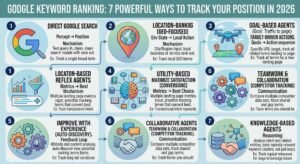
The seven methods below cover free monitoring, manual checks, automated tracking, competitor research, historical comparisons, and location-based analysis. Together, they create a much clearer picture of your keyword positions.
Google Search Console is one of the best starting points for keyword tracking. It shows the queries that triggered your pages and provides clicks, impressions, CTR, and average position. You can also group performance by pages, countries, devices, and dates.
The important detail is that Search Console reports average position, not one permanent ranking number. Google explains that this value averages the topmost position recorded across impressions. Your live search can therefore show another position.
Manual checking is useful when you want a quick snapshot. Search your target keywords and inspect the results for your page. This method works well for a few important terms, especially when you want to understand the current SERP layout.
However, don’t treat one search as absolute truth. Your search position can vary because of location, device, search history, and other factors. For serious SEO work, combine manual checks with historical ranking data.
A Google ranking checker automatically checks where your keywords appear. Instead of searching dozens of phrases yourself, you can monitor them from one dashboard. A good keyword ranking checker can also store historical data.
When choosing a checker, look for location tracking, mobile and desktop results, ranking history, competitor data, and reliable reporting. A free Google ranking checker may work for a small project, while larger websites often need more advanced tracking.
A dedicated SEO ranking tool gives you more control over ongoing monitoring. These platforms can organize keywords, track ranking changes, monitor competitors, and show visibility trends. Some also monitor SERP features and search results across different locations.
A good keyword position tracker saves time because it checks your selected terms automatically. This becomes especially useful for agencies, ecommerce websites, and businesses targeting several US cities or states.
Your competitors can reveal opportunities that normal ranking reports miss. Competitor rank tracking shows which searches bring visibility to competing websites. You can then study their content and identify gaps in your own strategy.
Use competitor keyword analysis to understand topics rather than copy pages. Look at their search intent, content depth, internal links, backlinks, and SERP coverage. The goal is to find weaknesses you can improve upon.
A single ranking check can mislead you. Historical ranking data gives you context. You may discover that a page moved from position 42 to 18 over several weeks, even though yesterday’s number looked disappointing.
Watch ranking changes over longer periods. Sudden movement can come from algorithm changes, competitor updates, technical issues, or normal search volatility. Google also recommends focusing on trends rather than treating position as the only success metric.
US businesses should pay close attention to location. A business may rank well in New York while performing poorly in California. Local intent can create major differences in website ranking across different markets.
Device data matters too. Mobile and desktop users can behave differently. Search Console lets you analyze performance by country and device, which helps uncover differences in visibility and CTR.
To check Google keyword ranking, start with the exact search terms that matter to your business. Then open Search Console and review queries, pages, clicks, impressions, CTR, and average position. This gives you real first-party search data instead of one manual search.
Next, compare important terms with a Google rank tracker or keyword position tracking tool. Record the results regularly. Over time, this creates a useful ranking history that shows whether your SEO work is actually producing progress.
| Step | What to check |
|---|---|
| 1 | Choose important keywords |
| 2 | Check Search Console |
| 3 | Review impressions and clicks |
| 4 | Compare average positions |
| 5 | Check mobile and desktop data |
| 6 | Compare locations |
| 7 | Track changes over time |
These phrases often describe nearly the same idea. Google keyword rank usually refers to where your page appears for a search term. Google search position can describe that same placement within Google’s search results.
The important difference appears when you use Search Console. Its average position is calculated from recorded impressions. It isn’t a promise that your page will appear at that exact number during your next search.
Your rankings can move for many reasons. Competitors may publish stronger pages. Google may interpret a query differently. Your content may become less relevant. Technical problems can also affect crawling, indexing, or page experience.
Normal ranking fluctuations don’t always require immediate action. First, compare several days or weeks of data. Look for meaningful changes in clicks, impressions, and visibility before making large SEO decisions. Google specifically recommends watching position changes over time.
A first-page ranking is generally valuable because users can discover your page without digging through many result pages. Positions near the top can provide strong visibility. Yet the best position depends on the query and the SERP layout.
A commercial keyword with strong buying intent can be more valuable than a high-volume informational term. Your search visibility, clicks, engagement, and conversions matter together. A ranking report should help you make better decisions rather than become a vanity scoreboard.
| Position range | General SEO meaning |
|---|---|
| 1–3 | Very strong visibility |
| 4–10 | Strong first-page opportunity |
| 11–20 | Major improvement opportunity |
| 21–50 | Developing visibility |
| 51+ | Needs stronger relevance or authority |
Better rankings start with better answers. Match your content with search intent before adding more keywords. If users want a comparison, give them a comparison. If they want instructions, give them a clear process.
Next, improve on-page SEO, internal linking, content depth, page speed, mobile usability, and technical SEO. Build relevant backlinks when appropriate. Refresh outdated information too. Every change should solve a real user problem instead of simply trying to manipulate a ranking signal.
One common mistake is checking rankings constantly. Daily changes can create unnecessary panic. Another mistake is treating average position as an exact live ranking. Search Console itself explains why those numbers can differ.
Another problem is focusing only on position. A keyword can climb while clicks stay flat. That may indicate weak click-through rate, poor search intent alignment, or a crowded SERP. Always connect ranking data with impressions, clicks, CTR, and conversions.
Different websites need different tools. Search Console is excellent for first-party performance data. A dedicated SEO rank tracker can add scheduled monitoring, historical comparisons, competitor tracking, and location-specific checks.
You may also find a Google position checker, Google keyword rank checker, or website ranking checker useful for quick analysis. The best setup depends on your website size, keyword count, budget, and reporting needs.
| Tool type | Best use |
|---|---|
| Google Search Console | Real Google search performance |
| Google rank tracker | Automated position monitoring |
| SERP tracker | SERP and ranking movement |
| Keyword research tool | Finding new opportunities |
| SEO analysis tool | Broader website analysis |
| Competitor tracker | Comparing competing domains |
A useful SERP checker can help you inspect search-result layouts. A SERP tracker can then monitor those results over time. For larger campaigns, a search engine rank tracker can make this process much easier.
Tracking numbers is only the beginning. You need to understand what those numbers mean. XpertCode can help businesses connect SEO rank tracking, content optimization, technical improvements, and broader SEO strategy into one practical workflow.
For example, a business might discover high impressions but very few clicks. That signal deserves investigation. The title, content alignment, SERP competition, and search intent may need improvement. Better tracking helps turn those clues into useful SEO decisions.
These questions cover the most common concerns people have when they start tracking rankings. The answers focus on practical SEO rather than complicated terminology.
The easiest starting point is Google Search Console. Open the Performance report and review your queries, pages, clicks, impressions, CTR, and average position. You can then use a keyword ranking tool for automated monitoring.
The best Google ranking checker depends on your needs. Small websites may need simple tracking. Agencies may need location data, competitor monitoring, historical reports, and multiple projects. Always compare accuracy, tracking frequency, locations, and reporting features.
To check website position on Google, search your target phrase manually for a quick view. For reliable monitoring, use Search Console and a dedicated tracker. Remember that your result can change by location, device, and search context.
A sudden drop can come from an algorithm change, competitor improvement, technical problem, indexing issue, content change, or SERP change. Check several days of data first. Then compare pages, queries, devices, countries, clicks, and impressions.
Weekly analysis works well for many websites. Daily tracking can help when you manage competitive campaigns or important launches. However, don’t react to every small movement. Keyword performance tracking becomes useful when you study trends over time.
Position one is excellent, but it isn’t the only valuable result. Positions two through ten can still generate strong traffic. The real goal is qualified visibility that produces clicks, engagement, leads, or sales.
Good SEO requires more than watching a number move up and down. You need to understand why that number changed. You also need to connect it with impressions, clicks, CTR, traffic, and business results.
Use Search Console for reliable first-party data. Add a suitable Google rank tracker when you need automated monitoring. Study competitors, compare locations, watch trends, and improve content based on real evidence.
The simple process is track, understand, improve, and measure again. That approach gives you a much stronger SEO foundation than chasing rankings blindly.
| Goal | Recommended approach |
|---|---|
| Check search performance | Google Search Console |
| Check a specific keyword | Google ranking checker |
| Monitor many keywords | SEO rank tracker |
| Watch SERP changes | SERP tracker |
| Study competitors | Competitor keyword analysis |
| Find new opportunities | Keyword research tool |
| Measure SEO progress | Search Console + ranking tracker |
Sources: Google Search Console documentation explains how impressions, clicks, CTR, and average position are measured. It also explains why average position can differ from an individual live search.
Google also recommends using performance trends, query data, country data, and device data to understand how your website performs in Search.
| Anchor Text | URL |
|---|---|
| SEO Rank Tracking | https://xpertcodes.com/seo-rank-tracking-complete-guide/ |
| SEO Optimization | https://xpertcodes.com/seo-optimization/ |
| Web Development | https://xpertcodes.com/web-development/ |
| UI/UX Design | https://xpertcodes.com/ui-ux-design/ |
Discover Google Keyword Ranking with 7 powerful ways to check your position, track changes, beat competitors, and improve your SEO rankings in 2026.