Close
Xpertcodes – Where Expertise Meets Innovation | Code | Consult | Expert
Ranking on Google is exciting. Staying there is much harder.A page can reach the first page today. It can drop several positions later. Another page may sit on page two for months. Then, suddenly, it can enter the top ten.This is why SEO rank tracking matters.
It helps you understand where your website appears in Google Search. It also shows how your keyword rankings, search visibility, and organic rankings change over time.
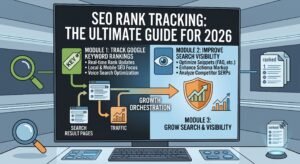
More importantly, good tracking helps you make better SEO decisions.You can find pages that are growing. You can spot ranking changes early. You can discover keywords sitting near page one. You can also see where competitors are gaining ground.
Google Search Console provides useful data for this work. Its Performance report includes clicks, impressions, CTR, and average position. You can also analyze queries, pages, countries, devices, and search appearances.
This guide explains SEO rank tracking from start to finish.You’ll learn how rankings work, how to check them, how to track them, and how to turn ranking data into real SEO growth.
SEO rank tracking is the process of monitoring where your website appears for specific search queries. A tracking system records your keyword position, search engine position, and movement over time.
For example, your page may rank at position 18 for “SEO services.” After improving the page, it may move to position 11. Later, it could reach position 6. That movement creates useful ranking data for your SEO strategy.
Rank tracking is not only about watching numbers. It helps you understand search engine rankings, content performance, and changes in organic visibility.
A good system connects rankings with clicks, impressions, CTR, traffic, conversions, and business goals.
| Tracking Area | What It Shows |
| Keyword position | Where a page ranks |
| Impressions | How often it appears |
| Clicks | How many users visit |
| CTR | How often users click |
| Ranking history | How positions change |
| Search visibility | How visible the site is |
| Conversions | Whether traffic creates results |
The real value comes from the pattern. One ranking is only a snapshot. A trend tells a much bigger story.
Without tracking, SEO becomes guesswork. You may publish content and hope it ranks. You may change titles without knowing whether they helped. You may also miss a serious ranking drop until traffic has already fallen.
With proper tracking, you can monitor Google rankings and compare results over time. You can see which pages are improving and which ones need work.This makes SEO monitoring more practical.
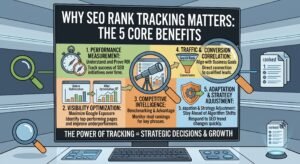
Imagine a page ranking at #14. That page is close to page one. A small improvement may create more visibility than publishing another completely new article.
This is one of the biggest opportunities in keyword rank tracking.Google also recommends focusing on trends in clicks and impressions instead of relying on average position alone.
| Without Tracking | With Tracking |
| SEO decisions are based on assumptions | Decisions use real data |
| Ranking drops can stay hidden | Drops can be identified |
| Opportunities are harder to find | Page-two opportunities become visible |
| Competitor movement is unclear | Competitor rank changes can be compared |
| Progress is difficult to prove | SEO progress becomes measurable |
The goal is not simply to rank higher.
The goal is to create stronger organic search traffic, better leads, more sales, and sustainable business growth.
A Google keyword ranking shows where a webpage appears in Google’s organic search results for a particular search query.
Suppose someone searches for “best SEO company.” If your webpage appears as the fifth organic result, its ranking position is approximately #5 for that search.However, Google Search is not a simple list anymore.
A modern Google SERP can contain ads, maps, images, videos, featured snippets, People Also Ask results, shopping results, and other search features.
That changes how users see organic results.Your page could have a strong Google search position but still receive fewer clicks than expected. The reason may be competition from other search elements.
Google explains that Search Console’s average position is calculated from recorded impressions. It is not necessarily the exact position you will see during one personal Google search.
| Term | Meaning |
| Google keyword position | Position for a specific query |
| SERP position | Position within search results |
| Search engine position | Your ranking location |
| Average position | Average recorded position |
| Organic ranking | Ranking without paid placement |
Understanding this difference prevents many SEO mistakes.
A rank tracking software system checks selected keywords and records where your website appears. It can store the result and compare it with previous checks.
A Google rank tracker may also collect information about location, device, competitors, SERP features, and ranking history.
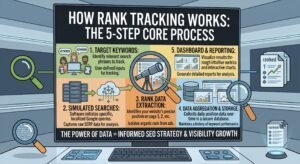
The exact features depend on the tool.For example, a local business may need local rank tracking. An international company may need country-level tracking. A mobile-first campaign may require mobile rank tracking.
This matters because rankings can vary by context.
| Tracking Type | Best Use |
| Desktop rankings | Desktop SEO analysis |
| Mobile rank tracking | Mobile search analysis |
| Local rank tracking | Local businesses |
| Location-based rankings | Regional campaigns |
| Competitor rank tracking | Market comparison |
| SERP tracking | Search-result monitoring |
A good keyword tracking tool therefore does more than report one position.
It gives you context.
The simplest way to check keyword rankings is through Google Search Console. Open the Performance report and review the Queries, Pages, Countries, Devices, and Search Appearance dimensions.
You can filter the report by query or URL. You can also compare time periods.Google Search Console reports clicks, impressions, CTR, and average position. It can therefore help you understand both ranking and search performance.
However, manually searching Google is not enough for serious keyword position tracking.Your personal search can differ from another person’s search. Location, search history, device, and other factors can affect what appears.
For ongoing monitoring, a dedicated SEO rank tracker can provide a more consistent tracking system.
| Method | Best For |
| Google Search | Quick manual check |
| Google Search Console | Real search performance |
| SEO rank tracker | Regular keyword monitoring |
| SERP tracker | Detailed SERP analysis |
| Analytics | Traffic and behavior |
The best approach is often to combine these data sources.
Google Search Console is one of the most useful free tools for understanding Google search performance.
Open the Performance report. Select Search results. Then review total clicks, total impressions, average CTR, and average position.
Next, open the Queries tab.
This reveals the search queries that generated impressions or clicks for your website.
You can then select a query and open the Pages tab. This helps you see which URL Google showed for that search.
Google also allows comparisons by date, country, device, and other dimensions.
| Search Console Metric | Meaning |
| Impressions | Search appearances |
| Clicks | Visits from search |
| CTR | Click percentage |
| Average position | Average recorded ranking |
| Query | Search term |
| Page | URL receiving visibility |
One important point matters here.
Search Console is not the same as a traditional rank tracker. It shows actual performance data from Google. A rank tracking platform usually checks selected keywords on a scheduled basis.
Both can be useful.
The difference between SEO rank tracking vs Google Search Console is important.
Search Console tells you how your site actually performed in Google. A dedicated rank tracker usually focuses on selected keywords and their tracked positions.
Search Console is excellent for discovering real queries. Rank tracking is useful for maintaining a controlled keyword set.
| Feature | Google Search Console | Rank Tracking Tool |
| Actual clicks | Yes | Usually limited |
| Impressions | Yes | Usually estimated |
| Average position | Yes | Yes |
| Selected keyword tracking | Limited | Strong |
| Competitor tracking | Limited | Strong |
| Location tracking | Yes | Strong |
| Ranking history | Yes | Strong |
| Scheduled reports | Limited | Usually strong |
| SERP features | Some | Often detailed |
The smartest strategy is not choosing one blindly.
Use Search Console to understand real search behavior. Use a SERP tracker when you need controlled keyword monitoring.
Strong SEO analytics needs more than ranking position.
You should connect SEO metrics with actual business outcomes. A keyword at #2 may look impressive. Yet it may generate fewer qualified leads than another keyword ranking at #8.
That is why SEO should be measured as a system.
| SEO Metric | Why It Matters |
| Keyword position | Shows ranking location |
| Impressions | Measures visibility |
| Clicks | Measures search visits |
| CTR | Measures search-result appeal |
| Organic traffic | Measures visitors |
| Conversions | Measures actions |
| Revenue | Measures business value |
| Engagement | Measures visitor quality |
Google defines CTR as clicks divided by impressions. It also explains that average position represents the average topmost position recorded for your property or page.
This means you should avoid judging SEO from one number.
Ranking data becomes useful when you connect it with business results.
A keyword position tells you where one result appears. Search visibility describes how strongly your website appears across a broader group of searches.
These are related, but they are not identical.
Suppose you rank #3 for one keyword but have almost no visibility for related searches. Your overall visibility may still be weak.
Now imagine another website ranks #7, #9, #11, and #13 for dozens of valuable terms. Its total organic visibility may be much stronger.
| Measurement | Focus |
| Keyword position | One search |
| SERP position | One result |
| Search visibility | Broader keyword set |
| Organic visibility | Organic exposure |
| Website visibility | Overall search presence |
This is why experienced SEO professionals track groups of related terms.
They look beyond a single ranking.
To track rankings over time, record the same keywords consistently. Keep the tracking location, device, language, and search engine settings consistent when possible.
Then compare periods.
A useful ranking history might show a keyword moving from #31 to #22, then #17, then #12.
That trend is more valuable than one isolated result.
Google also recommends using comparisons and focusing on significant changes instead of reacting to every small movement.
| Period | Ranking | Change |
| January | 31 | — |
| February | 22 | +9 |
| March | 17 | +5 |
| April | 12 | +5 |
| May | 8 | +4 |
This example shows steady progress.
It also gives you evidence that the page is moving in the right direction.
If you wonder why do keyword rankings change, the answer is rarely one simple factor.
Google continuously processes many signals. Competitors also publish new content. Pages get updated. Search intent can shift. Technical problems can appear. Google can release ranking system updates.
User behavior can change too.
For example, a page written for an old search intent may become less useful. Another competitor may publish a clearer and more complete answer.
This can create ranking fluctuations.
A small daily movement is not automatically a problem. Large and sustained movement deserves deeper investigation.
| Possible Cause | What to Check |
| Content change | Recent edits |
| Technical issue | Indexing and crawling |
| Competitor improvement | Competing pages |
| Search intent shift | Current SERP |
| Algorithm change | Google updates |
| Internal linking | Important page links |
| Backlink changes | Link profile |
| SERP changes | New search features |
Never panic over one bad ranking check.
Look for a pattern first.
One of the most valuable uses of SEO monitoring is finding pages that are already close to better rankings.
Page-two keywords are a classic example.
Suppose a page ranks around #12 for a valuable search. It already has some relevance. Improving the content, internal links, search intent match, title, structure, and supporting information may help it move closer to the top ten.
Google Search Console can help identify queries with impressions but weak click performance. Google specifically recommends examining high-impression, low-CTR opportunities.
| Opportunity | Possible Action |
| Position 11–20 | Improve content depth |
| High impressions, low CTR | Improve title and snippet |
| Rising query | Expand relevant section |
| Falling keyword | Audit page |
| Related query | Add useful coverage |
| Strong page with weak internal links | Improve linking |
This is often faster than starting from zero.
To improve keyword rankings, start with search intent.
Search your target query. Study the pages that already rank. Understand what users expect to find.
Then make your page more useful.
Do not simply repeat the keyword more times. Google does not need a page stuffed with the same phrase.
Instead, improve completeness, clarity, structure, examples, evidence, internal links, and user experience.
Google’s current documentation emphasizes creating useful, reliable content for people rather than producing content primarily to manipulate search rankings.
| Improvement | Purpose |
| Better search intent match | Answer the real query |
| Stronger title | Improve relevance and CTR |
| Better headings | Improve readability |
| Deeper information | Increase usefulness |
| Internal links | Strengthen topic connections |
| Updated facts | Keep information current |
| Better examples | Make concepts clearer |
| Stronger UX | Help users find answers |
The strongest SEO pages solve the searcher’s problem.
That should always come before keyword density.
To monitor Google search rankings, create a fixed group of important keywords.
Include commercial terms, informational terms, local terms, and important brand searches when relevant.
Then monitor changes on a consistent schedule.
A professional system should also separate keywords by topic. This makes it easier to understand which content clusters are growing.
For example, an SEO company could track “SEO services,” “technical SEO,” “local SEO,” and “SEO audit” as separate groups.
That creates clearer SEO reporting.
| Keyword Group | Purpose |
| Commercial | Find potential buyers |
| Informational | Capture research traffic |
| Local | Target nearby customers |
| Brand | Measure brand demand |
| Product | Capture product searches |
| Service | Measure service visibility |
This makes reports easier to understand.
It also helps connect rankings with the actual SEO strategy.
Competitor rank tracking shows where competing websites appear for the same search terms.
It can reveal gaps in your strategy.
Suppose your competitor ranks for 300 relevant terms while your website ranks for only 100. That difference may show opportunities.
However, copying every competitor keyword is a mistake.
Some keywords may have poor business value. Others may not match your products, services, or audience.
The better approach is to study patterns.
| Competitor Signal | SEO Question |
| Shared keywords | Where do we compete? |
| Competitor-only keywords | What gaps exist? |
| Better competitor position | Why is their page stronger? |
| New competitor rankings | What topics are growing? |
| Lost competitor rankings | Is an opportunity available? |
Good competitor keyword tracking helps you learn.
It should not turn your SEO strategy into imitation.
Local rank tracking measures how a website performs for searches connected to a specific location.
This matters greatly for businesses that serve customers in particular cities.
A website might rank well nationally but poorly in its target city. Location can therefore change the SEO picture.
For local campaigns, location-based rankings should be monitored carefully.
You may track searches such as “SEO agency near me,” “SEO services in London,” or “web development company in New York.”
| Local Tracking Factor | Why It Matters |
| City | Local relevance |
| Neighborhood | Smaller geographic targeting |
| Device | Mobile search behavior |
| Google Business Profile | Local visibility |
| Local landing page | Geographic relevance |
| Local competitors | Market comparison |
A strong local strategy combines rankings with local visibility, reviews, business information, and useful location-specific content.
Mobile rank tracking matters because people may see different search experiences on mobile and desktop.
The search page layout can change. Screen size changes the amount of visible information. User behavior can also differ.
That makes desktop rankings and mobile results worth monitoring separately when mobile search is important to your audience.
You should also inspect the actual mobile experience.
A page may rank well but still perform poorly if it loads slowly or is difficult to use.
| Device | What to Monitor |
| Mobile | Rankings and usability |
| Desktop | Rankings and search appearance |
| Tablet | Relevant audience behavior |
| All devices | Overall search performance |
Google Search Console lets you compare performance by device.
Ranking is only one part of the mobile SEO experience.
A search result page can contain much more than traditional blue links.
Modern SERP tracking should consider features that change how users interact with results.
These can include featured snippets, image results, video results, local features, People Also Ask, shopping elements, and other search appearances.
The exact result types vary by query.
This creates an important distinction between ranking and visibility.
| SERP Element | Potential Impact |
| Featured snippet | Can increase visibility |
| People Also Ask | Creates additional exposure |
| Images | Can attract visual searches |
| Videos | Helps video content |
| Local results | Important for local businesses |
| Shopping results | Important for ecommerce |
Google’s Search Console documentation also explains that different search result types can affect how impressions and positions are recorded.
Therefore, a modern SEO strategy should study the entire Google SERP.
Choosing SEO monitoring tools depends on your goals.
A small website may only need basic keyword monitoring. An agency may need hundreds or thousands of tracked terms, competitor analysis, location tracking, reporting, and historical data.
The tool should also make data easy to understand.
A complicated dashboard is not useful if nobody knows what action to take.
| Feature | Importance |
| Keyword tracking | Essential |
| Ranking history | Very useful |
| Competitor tracking | Useful |
| Local tracking | Essential for local SEO |
| Mobile tracking | Useful |
| SERP features | Useful |
| Reporting | Essential for agencies |
| Data export | Useful |
| Scheduled reports | Useful |
| Location settings | Important |
The best keyword rank tracker is not necessarily the one with the biggest feature list.
It is the one that helps you make better decisions.
Good ranking reports should answer questions.
They should not simply show hundreds of numbers.
A client usually wants to know whether visibility improved. They also want to understand which keywords grew, which pages changed, and what should happen next.
That is why keyword reports should connect ranking movement with actions.
A useful report might show current position, previous position, change, impressions, clicks, CTR, landing page, and recommended action.
| Keyword | Current | Previous | Change | Action |
| SEO services | 8 | 13 | +5 | Continue |
| SEO audit | 16 | 21 | +5 | Improve page |
| Technical SEO | 6 | 5 | -1 | Monitor |
| Local SEO | 12 | 9 | -3 | Investigate |
This makes SEO reporting easier to understand.
A report should help someone decide what to do next.
To measure SEO ranking performance, compare ranking data with actual search outcomes.
Start with keyword movement. Then check impressions. Next, review clicks and CTR. Finally, look at conversions and business value.
This creates a complete measurement chain.
Ranking → Visibility → Clicks → Traffic → Conversions → Revenue
A ranking increase without traffic may indicate a low-demand keyword. More impressions without clicks may indicate a weak title or search-result mismatch.
Google also recommends examining impressions, clicks, CTR, and position together rather than relying on position alone.
| Stage | Question |
| Ranking | Did our position improve? |
| Visibility | Are we appearing more often? |
| CTR | Are users clicking? |
| Traffic | Are visitors increasing? |
| Conversion | Are visitors taking action? |
| Revenue | Is SEO producing business value? |
This is how SEO becomes measurable.
The answer to how often should you track keyword rankings depends on the website and campaign.
Daily monitoring can be useful after major changes. Weekly tracking works well for many active SEO campaigns. Monthly reviews can reveal broader trends.
The important thing is not checking rankings every hour.
Google’s own guidance emphasizes analyzing trends and significant changes. Daily noise can distract you from the larger picture.
| Website Type | Practical Frequency |
| New website | Weekly |
| Active SEO campaign | Weekly |
| Major SEO change | Daily or frequent checks |
| Established site | Weekly or monthly |
| Large campaign | Automated monitoring |
Consistency matters more than obsession.
SEO is a long-term process.
Many websites track rankings but still make poor SEO decisions.
One common mistake is treating one keyword as the entire SEO strategy. Another is reacting to every small ranking movement.
Some people also focus only on position.
That can hide important information.
A page may rank at #7 but receive very few clicks. Another page may rank at #12 and generate strong impressions. The second page could be a better improvement opportunity.
| Mistake | Better Approach |
| Tracking one keyword | Track keyword groups |
| Checking position only | Include clicks and impressions |
| Reacting to daily noise | Study trends |
| Ignoring search intent | Review current SERP |
| Copying competitors | Find strategic gaps |
| Ignoring mobile | Compare devices |
| Ignoring local results | Track locations |
| Publishing without analysis | Use ranking data |
The goal is not to collect data.
The goal is to use it.
A useful workflow starts with keyword selection.
Choose terms that matter to your business. Group them by topic and intent. Then record their current performance.
Next, track positions consistently.
After that, review the data regularly. Find rising keywords, falling keywords, page-two opportunities, high-impression queries, and weak CTR areas.
Then take action.
Update content. Improve internal links. Fix technical problems. Improve titles where appropriate. Expand useful sections. Strengthen search intent alignment.
Finally, measure the result.
This creates a repeatable SEO system.
| Stage | Main Action |
| Research | Select valuable keywords |
| Baseline | Record current performance |
| Tracking | Monitor rankings |
| Analysis | Find changes |
| Optimization | Improve pages |
| Measurement | Compare results |
| Reporting | Document progress |
| Repeat | Continue the cycle |
The most important step is the final one. SEO improves through repeated learning.
Xpertcodes can use professional SEO rank tracking as part of a broader SEO strategy. The purpose is not simply to send ranking numbers.
The purpose is to understand search performance and turn data into useful optimization decisions.
For businesses targeting competitive markets, SEO rank tracking services can help monitor keyword movement, competitor visibility, search performance, and important ranking opportunities.
A stronger system can combine Google ranking tracking, keyword performance tracking, and SEO analysis.
This approach makes SEO more transparent.
For growing websites, SEO monitoring services can help identify changes before they become bigger problems.
Xpertcodes can also support keyword ranking services, SEO performance monitoring, and competitor keyword tracking as part of a wider campaign.
Local businesses can benefit from local SEO rank tracking. Larger websites may need broader location and device monitoring.
The key is to connect tracking with action.
| Xpertcodes SEO Area | Purpose |
| Google ranking tracking | Monitor important queries |
| Keyword performance tracking | Find winning terms |
| Competitor tracking | Understand competitors |
| Local SEO rank tracking | Measure local visibility |
| SEO reporting services | Communicate progress |
| Search visibility improvement | Increase organic exposure |
| SEO strategy | Plan next actions |
| SEO optimization services | Improve website performance |
A tracking dashboard is useful. A strategy built from that dashboard is even more valuable.
Imagine an online business has an article ranking at #16 for a valuable keyword.
The page receives 900 impressions every month. However, it gets only 12 clicks.
Instead of publishing another article, the SEO team investigates the existing page.
They review the search intent. They compare competing pages. They improve the introduction, expand missing sections, strengthen internal links, improve the title, and add clearer answers.
After several weeks, the page moves toward the top ten.
The example demonstrates an important principle.
Existing ranking data can reveal opportunities that new content cannot always provide.
| Before | After Optimization |
| Position 16 | Position 8 |
| 900 impressions | 1,500 impressions |
| 12 clicks | 90 clicks |
| Weak internal links | Strong topic connections |
| Limited intent coverage | Better intent match |
This is why find ranking opportunities should be part of your normal SEO process.
A strong keyword tracking strategy begins with business goals.Do not track hundreds of random phrases simply because a tool suggests them. Track searches that matter.

Commercial keywords can reveal buying intent. Informational keywords can build topical authority. Local keywords can attract nearby customers. Brand searches can measure awareness. Then create groups.
For example, an SEO company could create separate groups for technical SEO, local SEO, content SEO, link building, SEO audits, and general SEO services.
This creates cleaner keyword tracking.
| Keyword Type | Main Purpose |
| Commercial | Generate leads |
| Informational | Build authority |
| Local | Attract local customers |
| Brand | Measure awareness |
| Product | Drive product demand |
| Service | Capture service intent |
Your keyword set should evolve.
New search queries can reveal opportunities that were not visible during initial keyword research.
Ranking data can influence what you publish next.
Suppose one article ranks for 30 related queries. That suggests Google sees relevance across a broader topic.
You may then create supporting content around related questions.
This creates a topic cluster.
The main page can target the broad subject. Supporting pages can answer narrower questions. Internal links can connect them.
Over time, this can improve website rankings and topical relevance.
Google Search Console can help reveal unexpected search queries that already generate impressions.
| Ranking Discovery | Content Decision |
| New related query | Expand existing page |
| Repeated question | Create supporting content |
| Strong commercial query | Strengthen service page |
| High impressions | Improve CTR |
| Weak related page | Add internal links |
| New topic trend | Research future content |
This makes SEO more responsive. You are no longer publishing blindly.
CTR is one of the most useful parts of search performance.
Suppose your page receives 10,000 impressions but only 100 clicks. Its CTR is 1%.
That does not automatically mean the page is bad.
The query may have strong competition. The search result may contain many features. The keyword may have informational intent. The title may also fail to match the user’s expectations.
Google defines CTR as clicks divided by impressions.
The correct response is investigation.
| Situation | Possible Action |
| High impressions + low CTR | Review title and snippet |
| Low impressions + good CTR | Improve visibility |
| High rankings + low clicks | Inspect SERP |
| Low ranking + strong impressions | Improve page |
| Falling clicks + stable position | Check SERP changes |
This is where SEO analytics becomes practical.
A sudden drop deserves investigation.
First, confirm that the drop is real. Check a longer date range. Compare similar periods.
Then check whether impressions also dropped.
If both impressions and clicks decline, the page may have lost visibility.
If impressions stay stable but clicks fall, CTR or SERP behavior may be the bigger issue.
Google Search Console provides comparison tools that help identify significant query and page changes.
| Change | Possible Meaning |
| Position down + impressions down | Visibility problem |
| Position stable + clicks down | CTR/SERP issue |
| Position up + clicks up | Positive growth |
| Position up + conversions down | Traffic quality issue |
| Many pages fall together | Wider site issue |
Never make major changes before diagnosing the cause.
Good SEO starts with evidence.
Search Console contains more than a traffic number.
Its Queries report can reveal exactly what people searched when your site appeared.
You can sort queries by impressions, clicks, CTR, or position. You can also compare periods and filter data.
This creates opportunities for analyze ranking data workflows.
For example, a query with strong impressions but few clicks may deserve a better title. A query ranking around page two may deserve deeper content.
Google specifically recommends reviewing high-impression and low-CTR opportunities.
| Search Console Signal | SEO Opportunity |
| High impressions | Improve visibility or CTR |
| Low CTR | Review search snippet |
| Position 11–20 | Improve content |
| Rising query | Expand topic |
| Falling query | Investigate |
| Strong page | Build internal links |
This turns Search Console into an SEO decision system.
The best way to track keyword rankings is to combine several sources.
Use Google Search Console for actual search performance. Use an SEO tracking platform for a controlled keyword set. Use analytics for user behavior and conversions.
Then compare the information.
A ranking tool may tell you that a keyword moved from #9 to #12. Search Console can tell you whether impressions and clicks changed. Analytics can show whether visitors converted.
That creates a fuller picture.
No single metric tells the entire SEO story.
| Tool/Data Source | Main Strength |
| Search Console | Search performance |
| Rank tracker | Controlled keyword positions |
| Analytics | User behavior |
| Business data | Revenue and leads |
| SERP review | Search intent |
The strongest system combines them.
Long-term monitor Google search rankings strategies focus on trends.
You should track important keywords consistently. You should also document major website changes.
When rankings improve, record what changed.
When rankings decline, investigate what happened.
Over time, your ranking history becomes a valuable SEO record.
You can identify patterns that would otherwise remain hidden.
Maybe content updates work well for your website. Perhaps internal linking creates strong gains. Maybe certain topics require more authority.
Your data can reveal these patterns.
| Long-Term Signal | What It Can Teach |
| Consistent growth | Strategy is working |
| Repeated drops | Possible recurring issue |
| Strong page-two movement | Content has potential |
| Rising impressions | Growing visibility |
| Rising CTR | Better search appeal |
| Rising conversions | Better business impact |
This is how you track SEO progress instead of simply checking rankings.
SEO rank tracking is the process of monitoring where webpages appear for selected search queries. It records ranking position, movement, and historical changes.
It can help you understand whether your SEO work is improving visibility. It can also reveal ranking drops and new opportunities.
To how to track SEO rankings effectively, start with Google Search Console and a consistent keyword set. Add a dedicated rank tracker when you need scheduled keyword monitoring.
Compare rankings with impressions, clicks, CTR, traffic, and conversions.
To how to check Google keyword rankings, open Google Search Console and review the Performance report.
Use the Queries and Pages sections. You can also use a Google rank tracker for selected keywords and regular position checks.
To how to track keyword rankings in Google, select important keywords and monitor their positions consistently.
Google Search Console provides actual search performance. A dedicated keyword rank tracker can provide more controlled tracking.
To how to monitor keyword positions, track the same terms regularly. Keep location and device settings consistent where possible.
Then compare current rankings with historical results.
To how to improve Google keyword rankings, match search intent, improve content quality, strengthen internal links, fix technical problems, and make the page more useful.
Avoid repeating keywords unnaturally.
How often should you track keyword rankings depends on your website.
Weekly tracking works well for many SEO campaigns. Daily monitoring can help after major changes. Monthly analysis can reveal broader trends.
Google rankings change because search results are dynamic.
Competitors publish new pages. Existing content changes. Search intent evolves. Technical issues can occur. Google also changes its ranking systems.
What is keyword rank tracking? It is the process of recording where a website appears for specific search terms.
It helps measure ranking movement over time.
How does rank tracking work? A tracking platform checks selected keywords and records the ranking position of your website.
It can then compare current positions with historical data.
To how to track competitor keyword rankings, use competitor tracking tools that compare your domain with competing websites.
Study keyword gaps, shared rankings, position changes, and content patterns.
SEO rank tracking vs Google Search Console is mainly about purpose.
Search Console reports Google’s actual search performance. Rank tracking tools usually monitor a selected keyword set and provide controlled ranking history.
The best way to track keyword rankings is to combine Search Console, rank tracking, analytics, and business data.
This gives you ranking, visibility, traffic, and conversion information together.
To how to monitor Google search rankings, track important keywords consistently and review changes over time.
Do not react to every small fluctuation. Look for meaningful patterns.
To how to measure SEO ranking performance, connect rankings with impressions, clicks, CTR, organic traffic, conversions, and revenue.
A higher ranking is useful only when it supports meaningful business results.
Google rankings are not static numbers.
They move. They fluctuate. They respond to changes across search results, competitors, content, technology, and user behavior.
That is why SEO rank tracking should become part of your regular SEO process.
Use Google Search Console to understand real search performance. Use rank tracking tools when you need controlled keyword monitoring. Study competitors. Watch page-two opportunities. Analyze CTR. Track local and mobile performance.
Most importantly, turn data into action.
A ranking report cannot improve your website by itself.
Your decisions can.
When you monitor SEO performance, analyze ranking data, and improve pages based on evidence, SEO becomes more predictable and measurable.
The real objective is not simply reaching position #1.
It is building stronger search visibility, better organic search traffic, more qualified visitors, and sustainable business growth.
That is the real purpose of professional SEO.
| Topic | Read More |
|---|---|
| SEO Rank Tracking | SEO Rank Tracking: Complete Guide to Tracking Google Rankings |
| SEO Optimization | SEO Optimization Services: Improve Rankings, Traffic & Search Visibility |
| SEO Rank Hunter | What Is SEO Rank Hunter? |
| Rank Tracking Tools | How to Use SEO Rank Hunter to Supercharge Websites |
| Local SEO | Local SEO Services: Improve Local Search Visibility |
| Web Development | Web Development Services for SEO-Friendly Websites |
| SEO Agency | SEO Agency Interamplify: What You Should Know |
| Xpertcodes | Contact Xpertcodes |
For understanding how Google Search works and how to improve a website for search engines, Google’s official SEO Starter Guide is a strong primary reference.
Google Search Central — SEO Starter Guide
For SEO rank tracking, Google Search Console’s Performance report is especially important. It explains clicks, impressions, CTR, average position, queries, pages, and search-performance trends.
Google Search Console — Performance Report
For understanding how Google calculates and displays average position, Google provides detailed documentation about Search Console performance data and its aggregation methods.
Google Search Console — About Performance Data
For practical SEO analysis, Google’s official Search Console guide explains how to find ranking changes, analyze queries and pages, and track position history. Google also recommends focusing on trends in impressions and clicks instead of relying only on position.
Google Search Console — Common Tasks and Use Cases
For measuring search performance, Google explains how impressions, clicks, CTR, and other Search Console metrics can help website owners understand and improve their Google visibility.
Google Search Console — How Are You Performing on Google?
For additional search-engine data, Bing Webmaster Tools provides its own Search Performance report. It includes impressions, clicks, CTR, average position, keywords, pages, and ranking trends for Bing search.
Bing Webmaster Tools — Search Performance
Learn SEO Rank Tracking in 2026. Discover how to track Google keyword rankings, monitor SEO performance, find ranking opportunities, and improve search visibility.