Close
Xpertcodes – Where Expertise Meets Innovation | Code | Consult | Expert
If your website is getting impressions but very few clicks, there may be a simple reason. Your pages may already have Google keyword ranking visibility, but they may not be high enough to attract users.
This is where understanding keyword ranking becomes important.
A page can appear on Google without receiving much traffic. It can rank at position 8, 15, or 30. It can also move between positions from one day to another. These changes are normal. What matters is understanding why they happen and what you can do next.
Your goal is not to rank for every keyword on the internet. Your goal is to rank for the right searches with useful content.
In this guide, you will learn how Google search ranking works, how to check keyword ranking, how to understand impressions and clicks, how to find weak pages, and how to improve Google ranking over time.
You will also learn how to identify Page 2 keywords, improve low-ranking terms, use internal links, understand search intent, and build a practical SEO strategy.
| learn now | why support |
|---|---|
| SEO Rank Hunter | Google Keyword Ranking Checker / Tracking section |
| SEO Optimization | How to Improve Google Ranking section |
| SEO Services | SEO Strategy / Small Business section |
| Keyword Research | Keyword Research section |
| On-Page SEO | Content Optimization section |
| Technical SEO | Technical SEO section |
| SEO Audit | Ranking Drop / Troubleshooting section |
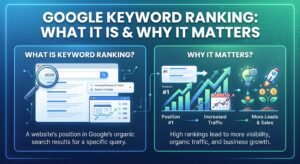
Google keyword ranking is the position where a webpage appears in Google’s search results for a specific search query. If your page appears near the top, it has a stronger ranking position. If it appears much lower, fewer people may see it.
For example, imagine you publish an article about SEO tools. Someone searches for “best SEO tools for small businesses.” If your page appears at position 4, your Google keyword position is much stronger than if it appears at position 48.
Your keyword position can change for many reasons. Competitors can publish better pages. Google can change how it evaluates results. Search intent can change. Your own page can become outdated. New websites can enter the results.
That is why keyword rankings should not be treated as a permanent score.
| Ranking Position | General Meaning | SEO Opportunity |
|---|---|---|
| 1–3 | Very strong visibility | Protect and improve |
| 4–10 | First-page visibility | Strong opportunity |
| 11–20 | Page 2 range | High improvement opportunity |
| 21–50 | Lower visibility | Content and relevance work needed |
| 51–100 | Weak visibility | Deeper SEO review needed |
A useful way to think about rankings is this: ranking is not the final goal. Visibility, clicks, useful traffic, and conversions matter more.
Google’s Search Console reports can help you understand how your pages perform in Search. Google has also clarified how clicks, impressions, and position are recorded in its Performance reporting.
Google does not rank pages simply because a keyword appears many times. Modern Google rankings depend on many signals and systems that help Google understand relevance, quality, usefulness, and the relationship between a query and a page.
When someone searches, Google tries to return results that best satisfy that person’s need.
That means content relevance matters. A page about beginner SEO should not try to compete for a search that requires advanced technical documentation unless it actually provides that depth.
Google also needs to understand the page itself. Clear titles, useful headings, descriptive text, links, structured information, and good page organization can help search engines understand the content.
The question of how Google ranks websites is much broader than one ranking factor.
Google uses automated systems that evaluate many signals and relationships. The exact weighting of these systems is not publicly provided as a simple formula.
This is why SEO professionals should avoid claims such as “this one trick will guarantee position one.”
There is no reliable shortcut that guarantees a specific search engine position.
Instead, build a page that answers the searcher’s question better than competing pages.
Understanding how Google ranks pages also requires looking at the query.
The same website can rank extremely well for one topic and poorly for another.
That happens because Google evaluates individual pages in relation to searches.
A strong website does not automatically make every page strong.
Your page ranking depends on the page, the query, the competition, the content, the user need, and many other signals.
The easiest way to check Google keyword ranking is through Google Search Console.
Search Console provides information about how your website appears in Google Search. It can show queries, clicks, impressions, click-through rate, and average position.
This makes Google Search Console one of the most useful free tools for understanding organic performance.
Instead of guessing which keywords bring visibility, you can inspect the actual search queries associated with your site.
You can then compare your search impressions with your search clicks.
For example, suppose a page receives 2,000 impressions but only 20 clicks. That page has visibility, but its traffic opportunity may be much larger.
If you want to check keyword position in Google, start with Search Console.
Open the Performance report. Look at the queries and pages generating visibility. Then examine the average position.
Remember that average position is not necessarily the exact position you see every time you search manually.
Search results can vary based on factors such as location, device, search context, and other conditions.
That is why professional keyword tracking uses data over time instead of relying on one manual Google search.
Many SEO professionals use a Google keyword ranking checker to monitor selected keywords.
A Google ranking checker can be useful when you want to track specific terms regularly.
A dedicated keyword position checker may show historical changes. It can also help you compare multiple keywords or competitors.
Google Search Console has a different strength.
It shows actual search performance for your website.
| Tool Type | Main Purpose | Best Use |
|---|---|---|
| Google Search Console | Real Google Search performance | Queries, clicks, impressions, position |
| Google rank tracker | Track selected keywords | Daily or weekly monitoring |
| SEO rank tracker | Broader SEO monitoring | Keyword and competitor tracking |
| Google keyword ranking checker | Check selected positions | Quick ranking checks |
| keyword position checker | Monitor keyword positions | Position changes |
You don’t necessarily need every tool.
For a small website, Search Console can provide a strong starting point.
As your SEO program grows, a dedicated keyword rank tracker can make monitoring easier.
These terms sound similar because they describe closely related concepts.
Google search position usually refers to where a result appears in Google Search.
keyword search position describes the position of a webpage for a specific keyword or query.
Google ranking position refers to the result’s placement in Google’s results.
A SERP position is the location of a result on a search engine results page.
You may also see the term SERP keyword position in SEO tools.
These terms are useful, but don’t become obsessed with one number.
A keyword moving from position 9 to 7 can be positive.
But if the keyword has almost no search demand, that improvement may not generate meaningful traffic.
Organic keyword ranking refers to a webpage’s position in unpaid search results.
This is different from paid advertising.
If your page appears because Google considers it relevant to the query, that is an organic result.
Strong organic rankings can generate valuable organic search traffic without paying for every click.
However, organic traffic is not free in the broad sense.
You invest time, research, content, technical work, links, updates, and ongoing optimization.
The benefit is that a strong page can continue attracting visitors long after publication.
Your website ranking on Google is not one universal number.
A website can have hundreds or thousands of pages.
Each page can rank for many queries.
One article might have excellent Google website ranking for several terms. Another page may receive almost no visibility.
That is why SEO analysis should focus on pages and queries rather than treating the whole domain as having one ranking score.
A modern Google results page can contain different result types.
You may see traditional organic listings, featured elements, images, videos, maps, shopping results, news, and other search features.
This affects how much attention a traditional organic result receives.
Your Google SERP ranking therefore matters, but the layout around your result matters too.
A result at position 4 may perform differently depending on what appears above it.
This is one reason organic CTR can vary significantly between queries.
A high ranking can help visibility, but a compelling title and useful search snippet can also influence whether users choose your result.
Many beginners ask how to rank keywords as if ranking were something you can directly switch on.
It isn’t.
You create conditions that make a page more useful and relevant.
Start by understanding the query.
Then study the pages already ranking.
Look at what they explain.
Look for missing information.
Find questions that competing pages answer poorly.
Then create something better.
This process is part of keyword research, but modern SEO requires more than collecting keywords.
You need to understand why someone searches.
That is search intent.
Search intent optimization is one of the most important parts of modern SEO.
Imagine someone searches:
“how to check keyword ranking”
They probably want a practical guide.
They may want a tool.
They may want instructions.
They probably don’t want a 2,000-word history of search engines.
Now imagine someone searches:
“Google keyword ranking checker”
That search may have stronger tool or commercial intent.
Your page needs to match that need.
This is why search intent should influence your title, introduction, headings, examples, and overall structure.
A useful content strategy can group searches into informational, commercial, navigational, and transactional needs.
| Search Type | Example | Likely User Need |
|---|---|---|
| Informational | What is keyword ranking? | Learn |
| Informational | How to check Google rankings? | Get instructions |
| Commercial | Best rank tracker | Compare tools |
| Transactional | Buy SEO rank tracker | Purchase |
| Navigational | Google Search Console | Find a service |
Your target keywords should match the purpose of the page.
Do not force a sales page to answer a purely educational query.
Likewise, don’t turn a simple definition page into an aggressive sales pitch.
If you want to know how to improve Google ranking, start with the page itself.
Ask a simple question:
Does this page give the reader a better answer than the pages already ranking?
If the answer is no, adding more keywords may not solve the problem.
Better content quality comes from useful information, clear explanations, original insights, accurate facts, examples, and good organization.
Content optimization should improve the page for humans first.
Your title should accurately describe the content.
Your introduction should answer the main question quickly.
Your headings should guide the reader.
Your paragraphs should stay focused.
Your examples should make difficult ideas easier.
Google’s current spam guidance warns against creating large amounts of unoriginal content mainly to manipulate rankings. Google specifically emphasizes that scaled content abuse can involve producing many pages with little value, regardless of whether automation or AI was used.
That makes originality especially important for long-term SEO.
Everyone wants to know how to get Page 1 on Google.
There is no guaranteed formula.
But there is a practical strategy.
First, identify pages that already have some visibility.
Then find keywords where those pages rank below the top results.
These are often easier opportunities than starting from zero.
Suppose an article ranks at position 17.
That is a Page 2 keyword.
The page already has some relevance.
Instead of creating another article, you may be able to improve the existing page.
This can include better coverage, stronger search intent alignment, clearer structure, updated information, stronger internal links, and better user experience.
To move keyword to Page 1, first identify why the page is not already there.
Compare your page with the top results.
Look at content depth.
Look at the questions they answer.
Look at their examples.
Look at their structure.
Look at the search intent.
Then improve your page where it genuinely lacks value.
Do not simply make the article longer.
A 3,000-word article is not automatically better than a 1,500-word article.
Useful information beats unnecessary length.
Your low hanging keywords can become some of your best SEO opportunities.
These are often terms where your page already has impressions but ranks below the strongest positions.
For example, keywords ranking positions 11-20 are worth investigating.
They sit around the second page of results.
If a page ranks at position 13 for a valuable query, it may need less work than a completely new page trying to rank from nowhere.
This is where you can improve low ranking keywords through targeted optimization.
Page 2 keywords are not failures.
They are opportunities.
A page appearing around positions 11–20 has already passed some level of Google’s relevance test.
The challenge is getting it closer to the strongest results.
Look at the query.
Look at the page.
Look at the competitors.
Then find the gap.
| Situation | Possible Action |
|---|---|
| Position 11–20 | Improve relevance and depth |
| High impressions, low CTR | Improve title and snippet appeal |
| Low impressions | Review keyword demand and intent |
| Ranking for wrong query | Improve search intent alignment |
| Old content | Add accurate new information |
| Weak internal connections | Add relevant internal links |
| Poor page experience | Improve usability and technical SEO |
Sometimes you open Search Console and notice that your rankings dropped.
That can be frustrating.
But don’t immediately panic.
A Google ranking drop can happen for many reasons.
Your competitors may have improved.
Google may have changed its systems.
Search intent may have shifted.
Your page may have become outdated.
Your site may have technical problems.
Your page may have lost useful internal links.
Sometimes the change is temporary.
If you have lost keyword rankings, compare different time periods.
Don’t compare one random day with another.
Look at weeks or months.
Check whether the decline affects one keyword, one page, one category, or the whole site.
This distinction matters.
If only one article dropped, the problem may be specific to that page.
If hundreds of pages dropped together, investigate broader technical or algorithm-related causes.
A Google algorithm update can change how search results are evaluated.
But not every ranking change is caused by an algorithm update.
Normal keyword ranking fluctuations happen every day.
Competitors publish new pages.
Old pages get updated.
Search demand changes.
Google tests different results.
Users behave differently.
These factors can create ranking position changes without a major update.
Google also maintains documentation about its ranking systems and updates. Its documentation is regularly revised, including changes to how publishers should understand traffic drops and ranking systems.
So when traffic falls, investigate before making large changes.
A good keyword ranking analysis starts with actual data.
Search Console can show which queries produce impressions and clicks.
It can also show which pages receive visibility.
This allows you to identify:
high impression keywords
low CTR keywords
pages with strong clicks
pages with weak clicks
queries ranking near Page 1
queries with unexpected visibility
The important thing is to connect the numbers.
Suppose one page receives 10,000 impressions and 100 clicks.
Another receives 1,000 impressions and 150 clicks.
The second page has fewer impressions but more clicks.
That tells you something about relevance and user response.
Search impressions show visibility.
Search clicks show visits generated from Search.
The relationship between them helps you understand impressions to clicks.
Your click-through rate is another useful metric.
CTR can be calculated as clicks divided by impressions.
For example:
| Impressions | Clicks | Approx. CTR |
|---|---|---|
| 1,000 | 10 | 1% |
| 1,000 | 50 | 5% |
| 1,000 | 100 | 10% |
| 1,000 | 200 | 20% |
A high-impression page with a weak CTR may have a strong opportunity.
But don’t change titles blindly.
First understand the query and ranking position.
High impression keywords are often excellent opportunities.
Imagine a page receives 5,000 impressions but only 30 clicks.
The page is being seen.
But users are not choosing it often.
This can happen because the page ranks too low.
It can also happen because the title does not match the query well.
The result may also face strong competition from featured elements, videos, images, ads, or well-known brands.
Start by checking the actual search queries.
Then compare your result with competitors.
Ask whether your title clearly promises the information users want.
Ask whether your page actually delivers that promise.
Don’t write clickbait.
A strong title should attract attention while accurately representing the page.
Google’s documentation notes that snippets primarily come from page content, so clear and useful page text matters.
Internal links for SEO connect related pages within your website.
They help readers discover more information.
They also help search engines understand relationships between pages.
For example, an SEO website might connect:
keyword research → keyword ranking → technical SEO → internal linking → content optimization
This creates a useful topic relationship.
SEO internal linking should be natural.
Do not add links simply to increase the number of links.
Link when the reader would benefit from the next page.
Use descriptive anchor text.
For example, instead of:
“Click here”
you could write:
“learn more about keyword research”
The anchor should make sense in the sentence.
Internal links can also help you connect a strong page with a newer page.
This creates a clearer site structure.
Backlinks and rankings are often discussed as if links automatically create higher positions.
They don’t.
A backlink can be useful when it comes from a relevant, trustworthy source.
But buying large numbers of low-quality links is not a sustainable SEO strategy.
Focus on earning links because your content is worth referencing.
Original research helps.
Useful statistics help.
Strong guides help.
Unique examples help.
Expert commentary can help.
The goal should be real editorial value, not simply collecting URLs.
Domain authority and page authority are commonly used SEO industry metrics.
They can be useful for comparing websites within a particular tool.
But don’t confuse them with Google’s own ranking score.
Google does not publish one universal “Domain Authority” number that determines rankings.
Your page can rank well even if a third-party tool gives your domain a modest score.
Likewise, a site with a high third-party authority score can still have pages that perform poorly.
Use these metrics as references.
Don’t treat them as Google’s official ranking formula.
Technical SEO helps search engines access, understand, and process your website.
A technically strong site can make crawling and indexing easier.
Technical problems can create barriers.
Examples include broken pages, incorrect canonical signals, blocked resources, poor mobile usability, slow experiences, and indexing problems.
But technical SEO is not about making every technical score perfect.
It is about removing meaningful barriers.
Mobile SEO matters because many people browse from phones.
Your content should be readable.
Buttons should be usable.
Pages should load properly.
Navigation should work.
Core Web Vitals are Google’s page experience metrics related to loading performance, responsiveness, and visual stability.
They are useful technical measurements.
But don’t expect a perfect score alone to push a weak page to position one.
A technically perfect page with poor content can still lose to a more useful page.
Good keyword research is not about finding the largest possible search volume.
It is about finding searches that match your business, audience, content, and expertise.
A smaller keyword can sometimes produce better traffic than a huge keyword.
Why?
Because the smaller query may have stronger intent.
For example, someone searching:
“SEO”
has a very broad need.
Someone searching:
“how to check keyword ranking in Google Search Console”
has a much clearer need.
That makes the second query easier to satisfy with a focused guide.
A page can have a primary keyword.
It can also target related secondary keywords.
For example, the primary topic could be Google keyword ranking.
Related terms might include keyword position, Google Search Console, keyword tracking, and SERP position.
You don’t need a separate page for every tiny variation.
One comprehensive page can naturally cover many related searches.
Long-tail keywords are often more specific searches.
They can have lower individual search volume.
But they may have clearer intent.
For example:
“keyword ranking”
is broad.
“how to check keyword ranking in Google Search Console”
is much more specific.
Specific searches can help smaller websites compete for useful traffic.
This is especially valuable when your site is still building authority.
Instead of chasing only giant keywords, find realistic opportunities.
That is how SEO keyword opportunities can grow over time.
Studying competitor rankings can reveal topics you missed.
Suppose a competitor ranks for a question your website barely covers.
Don’t copy their article.
Study the user need.
Find the missing angle.
Then create your own original resource.
This is especially useful when your competitors have strong visibility but weak explanations.
Your goal is not to reproduce their structure word for word.
Your goal is to understand the market and create something better.
Imagine a small business website publishes an article about “SEO packages.”
After several months, the page receives 3,500 impressions.
It ranks around position 16 for several useful searches.
The owner might think the page failed.
It didn’t.
The page has already gained visibility.
The next step is ranking improvement.
The owner studies the queries.
Several are related to pricing, package types, local businesses, and monthly SEO services.
The page is updated to answer these questions more clearly.
Relevant internal links are added.
Outdated sections are improved.
The title is made more precise.
The content is reorganized around search intent.
Over time, some Page 2 keywords can move toward Page 1 rankings.
The important lesson is simple:
Don’t always create a new page when an existing page already has search visibility.
A useful SEO strategy starts with data.
Find pages that already receive impressions.
Find queries where those pages rank between positions 5 and 30.
Then prioritize the strongest opportunities.
You should consider search intent, business value, traffic potential, competition, and how closely the query matches your existing content.
A simple workflow looks like this:
| Stage | What to Analyze | Goal |
|---|---|---|
| Discovery | Queries and pages | Find opportunities |
| Analysis | Position and impressions | Find weak rankings |
| Intent | Search purpose | Improve relevance |
| Optimization | Content and structure | Improve usefulness |
| Internal linking | Related pages | Strengthen site structure |
| Monitoring | Rankings and traffic | Measure progress |
| Updating | New data and gaps | Maintain relevance |
This process is more sustainable than publishing random articles every day.
Keyword rank tracking becomes more useful when you track trends instead of individual days.
For example, imagine your ranking history looks like this:
| Month | Average Ranking Position |
|---|---|
| January | 34 |
| February | 27 |
| March | 21 |
| April | 16 |
| May | 11 |
| June | 8 |
That tells a much better story than checking one morning’s result.
You can see the direction.
The same principle applies to clicks and impressions.
A page that gradually improves from position 35 to position 12 may be making excellent progress even though it is not yet in the top 10.
A useful keyword ranking report should answer questions.
Which keywords improved?
Which keywords declined?
Which pages gained clicks?
Which pages gained impressions?
Which queries have strong impressions but weak CTR?
Which ranking keywords are close to Page 1?
A good report can be simple.
| Metric | What It Tells You |
|---|---|
| Clicks | Traffic from Google |
| Impressions | Search visibility |
| CTR | Click efficiency |
| Average position | Approximate ranking performance |
| Query | What users searched |
| Page | Which URL appeared |
A monthly Google ranking report can help you identify trends.
It can also help you decide which pages deserve more work.
Content freshness matters when information changes.
This is especially true for technology, cybersecurity, software, prices, regulations, and current events.
But updating a date alone does not make content fresh.
If you change “2025” to “2026” without improving the information, you haven’t really updated the page.
A useful update adds value.
It may include new facts, new examples, updated screenshots, revised recommendations, new statistics, or better explanations.
Freshness should serve the reader.
Not the ranking system.
A page does not become more relevant because the same keyword appears 50 times.
In fact, excessive repetition can make the writing uncomfortable.
Good content relevance comes from covering the topic properly.
For this article, that means discussing rankings, positions, Search Console, CTR, impressions, search intent, content quality, internal linking, technical SEO, and ranking improvements.
The words are connected because the concepts are connected.
That is much stronger than repeating one phrase in every paragraph.
On-page SEO helps you make the page clear and useful.
Your title should describe the topic.
Your headings should organize the information.
Your content should answer the query.
Your images should have useful context where appropriate.
Your internal links should connect related pages.
Your URLs should be understandable.
Your page should be easy to read.
Good content optimization means improving the page.
It does not mean inserting every variation of a keyword.
Use natural language.
Write for the reader.
Explain terms.
Use examples.
Answer related questions.
If a keyword does not fit naturally, don’t force it.
Your website ranking can look strong when you check one keyword.
But that doesn’t mean your entire website dominates Google.
A website can have:
strong rankings for 10 keywords
average rankings for 100 keywords
weak rankings for 1,000 keywords
That is normal.
SEO is a collection of pages and queries.
Each page has its own URL ranking opportunities.
This is why professional analysis looks at query-level and page-level performance.
Page 1 rankings usually offer stronger visibility than lower positions.
But position alone doesn’t tell the entire story.
A low-volume keyword at position 1 may produce less traffic than a high-demand keyword at position 5.
Likewise, a commercial keyword may be more valuable than a broad informational keyword.
The best SEO strategy connects ranking potential with business value.
Ask:
If this keyword ranks, will the visitor actually care about what my website offers?
That question can save you months of wasted work.
One of the biggest SEO opportunities is improving existing pages.
If a page already has keyword visibility, don’t automatically replace it.
Look at its data.
Find its best queries.
Find its weak queries.
Look for content gaps.
Improve the page.
Add useful internal connections.
Then monitor the results.
This is often more efficient than constantly creating new pages.
The goal is not more URLs.
The goal is better pages.
Google’s current spam guidance specifically warns against creating large amounts of unoriginal content primarily to manipulate search rankings.
Many websites make the same mistakes.
They target keywords without understanding intent.
They publish thin content.
They repeat keywords too much.
They ignore existing pages.
They chase ranking positions without checking traffic.
They never update outdated content.
They create weak internal linking structures.
They focus only on backlinks.
They ignore technical problems.
They panic after normal ranking changes.
The biggest mistake is treating SEO like a button.
You publish.
You rank.
You win.
Real SEO is rarely that simple.
It is a continuous process of research, publishing, measurement, improvement, and learning.
Google keyword ranking is the position of a webpage in Google’s organic results for a particular search query.
You can use Google Search Console to review queries, clicks, impressions, and average position. Dedicated ranking tools can also monitor selected keywords.
There is no single best tool for every website. Search Console is excellent for actual Search performance, while a dedicated Google rank tracker can help monitor selected keywords over time.
Average position represents an average of your site’s positions across impressions in the selected reporting period. It should not be treated as a guaranteed fixed position for every search.
There is no fixed timeline. New pages can take weeks or longer to gain meaningful visibility. Competition, content quality, site history, technical health, query intent, and many other factors can influence the timeline.
To how to rank higher on Google effectively, focus on satisfying search intent, creating useful content, improving technical health, building a clear internal linking structure, and earning relevant authority.
To move keyword to Page 1, first identify why the current page is weaker than the results above it. Improve the information gap, search intent alignment, page structure, internal links, and overall usefulness.
A Google ranking drop can have many causes. Competitors may improve. Search behavior may change. Your content may become outdated. Technical issues may appear. Google may also change its systems.
Low hanging keywords are often terms where your website already has some visibility but could realistically improve with focused optimization.
Yes. Page 2 keywords can be valuable because the page already has some visibility. Improving a relevant position 11–20 keyword can sometimes be more practical than starting a completely new page.
Relevant, useful backlinks can support a site’s authority and discovery. But backlinks and rankings should not be treated as a simple one-to-one relationship. Quality and relevance matter.
No. Domain authority is a third-party SEO metric, not a publicly published Google ranking score.
Yes. Technical SEO can help search engines crawl, index, and understand your website. It also helps remove technical barriers that can harm users or search visibility.
Understanding Google keyword ranking changes the way you approach SEO.
You stop looking at rankings as simple numbers.
Instead, you start seeing patterns.
A page at position 18 is not necessarily a failure.
It may be an opportunity.
A page with 10,000 impressions and 100 clicks may need a different strategy than a page with 200 impressions and 50 clicks.
A ranking drop does not always mean your site is broken.
A high ranking does not always mean the keyword is valuable.
The best SEO decisions come from context.
Use Google Search Console to understand your real search data. Use keyword tracking to monitor important terms. Study search intent before creating or changing content. Improve pages that already have visibility. Build relevant internal linking between related topics. Keep important information accurate and current.
Most importantly, create content that deserves to rank.
Google’s current guidance continues to emphasize useful, reliable, people-first content. Its documentation also warns against content created primarily to manipulate search systems.
That gives you a simple long-term principle:
Don’t build pages just to rank. Build pages that give people a reason to choose your result.
When you combine useful content with smart keyword research, strong on-page SEO, clean technical foundations, relevant links, and consistent measurement, your SEO performance becomes easier to understand and improve.
And that is the real goal of keyword ranking Google strategy.
Not just reaching Page 1 once.
Building a website that can earn and keep valuable organic visibility over time.
Check Google keyword ranking, track keyword positions, understand Search Console data, and learn proven ways to improve your rankings and reach Page 1 in 2026.
| Trusted Source | What It Supports |
|---|---|
| Google Search Central — SEO Starter Guide | Supports basic SEO practices, search visibility, website structure, and creating content that helps search engines understand pages. |
| Google Search Console — Performance Report | Supports search clicks, search impressions, CTR, queries, pages, and average position data. |
| Google Search Central — Creating Helpful Content | Supports people-first content, originality, usefulness, and creating content for users rather than search engines. |
| Google Search Central — Spam Policies | Supports guidance about keyword stuffing, scaled content abuse, and search manipulation. |
| Google Search Central — Ranking Systems | Supports Google’s explanation of its automated ranking systems and how search results are generated. |
| Google Search Central — Core Web Vitals | Supports Core Web Vitals, page experience, loading performance, responsiveness, and visual stability. |
| Google Search Central — Links | Supports crawlable links, internal linking, and helping Google discover pages. |
Good for service-based businesses.Have questions or need support? Our team is here to help you every step of the way.